Business to Arts launch new survey on sponsorship

In the next few days arts & cultural organisations will be receiving a link to an online survey conducted by Business to Arts, seeking information about levels of private giving. As anyone who works in Irish development knows, information on the arts sector & giving is very hard to come by, so this is an essential effort to share knowledge and improve resources for arts development!

Please complete, don’t delete, if you receive one of these surveys in your inbox!

For more information on the survey, see the announcement below:

Business to Arts announce new
Private Investment in the Arts Survey
Questionnaires going to arts organisation in the coming day
s

Continue reading

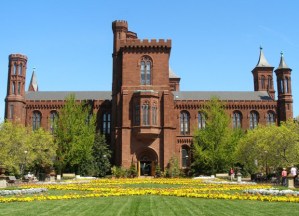
Smithsonian reins in top earners

Big cuts have been announced to the salaries of the top-paid employees at the Smithsonian, in an effort to curb exponential growth in executives’ salary:

According to figures released recently after a request by The Associated Press, the chief financial officer for the Smithsonian Institution could have the biggest reduction. If the cuts planned for five years from now were made today, CFO Alice Maroni could lose as much as $120,000, or 41 percent of her base salary of $293,280. Others could have reductions ranging from $6,000 to more than $80,000 a year.

Nonprofit watchdogs and members of Congress have been questioning salaries at the Smithsonian since former Secretary Lawrence Small’s compensation grew to nearly $916,000 for 2007. Small resigned in March 2007 when it was revealed that he was also charging the Smithsonian for housekeeping and repairs to his home swimming pool, among other expenses.

[…]

Critics aren’t sure the Smithsonian has done enough. They question why [new Smithsonian secretary] Clough is paid more than the U.S. president, who earns $400,000 a year.

“One has to ask, what’s the logic of paying Clough $500,000 and then paying the others so much less?” said Pablo Eisenberg, a senior fellow at Georgetown University’s Public Policy Institute who studies nonprofit leadership. “I don’t think that makes for very good morale among staff.”

(read the rest of the article)

Yikes. Somehow I think this is one financial model Irish arts institutions won’t be following…

Thanks to Kevin O’Dwyer for passing this news article along.

IMMA’s collections in crisis

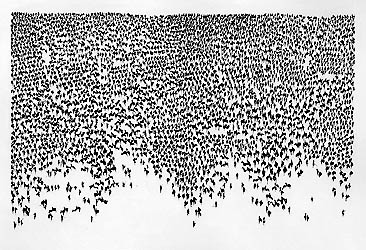
Part of the Tain tapestry series by Louis le Brocquy, one of the works currently suffering from poor storage conditions

A Tain tapestry by Louis le Brocquy, one of the IMMA works suffering from poor storage conditions

IMMA’s storage crisis made the front page of the Irish Times over the weekend, as a report obtained by the IT through Freedom of Information detailed the extent of damage that’s been done to the permanent collection due to inadequate storage facilities. This is the second revelation in recent months of serious mismanagement of national collections (following a damning audit of the National Museum’s collections by the Office of the Comptroller and Auditor General). The five-year-old IMMA report, authored by collections curator Catherine Marshall, details buckling of artworks, prints adhering to glass, and bloom appearing on metal sculptures– such damage making the works in storage ‘dangerous to handle’ unless absolutely necessary.

A second piece in the IT continued the IMMA story further:

Imma’s own on-site stores at its home at the Royal Hospital Kilmainham (RHK) were crammed with artworks, constituting a serious hazard as they could not be evacuated in the event of a fire and had no proper environmental controls to protect fragile works of art. With well over 1,000 works in its permanent collection by then, the vast bulk was being housed in “temporary” and “interim” warehouses and stores sourced off-site by the Office of Public Works (OPW), none of which were really suitable for storing art.

So critical had the storage situation become that Imma was forced to store works in a shipping container in the car park. The use of the shipping container was described as an emergency solution. But the “emergency” lasted four years. In September 2007, Imma’s director Enrique Juncosa wrote to Sean Benton, the chair of the OPW, again highlighting its storage problems.

Continue reading

How much is that oboe in the window?

Yesterday a new pilot scheme was announced by Music Network (supported by the Arts Council and the IRMA Trust) that will enable the purchase of instruments and renting of rehearsal spaces. Full application details can be downloaded from Music Network:

The Arts Council, The IRMA Trust and Music Network are pleased to announce new supports for capital investment in music in 2008. The Music Capital Scheme is a three-year pilot project that is part of a research initiative seeking to analyse the needs for support for capital investment in music as well as the optimum ways of providing this support.

In 2008, the first year of the project, financial support will be offered in three distinct streams that will run concurrently:

  • Stream 1: Instrument Banks – support for the purchase of instruments for non-professional groups/ensembles such as brass and silver bands, concert bands, symphonic wind ensembles, pipe bands, céilí bands, youth/amateur orchestras and ensembles, fife and drum (and other marching) bands, big bands, community music groups, percussion and samba groups, pop/rock music collectives, traditional music groups/organisations, choirs, other non-professional groups/ensembles
  • Stream 2: Individual Instruments – support for the purchase of high quality musical instruments for highly skilled individual performers playing at a professional level
  • Stream 3: Rehearsal Equipment – (Funded by once-off donation from The IRMA Trust) support for the equipping of dedicated rehearsal facilities for youth bands in conjunction with local authorities, venues, youth agencies and/or other organisations

Creating a culture of giving

This week saw the launch of a campaign in the UK to bolster levels of private philanthropy and reform the current philanthropic tax code: ‘Private Giving for the Public Good‘. Sponsored by The National Museum Directors’ Conference, The Museums, Libraries and Archives Council, and Arts Council England, the launch of the campaign was lauded by Nick Serota in The Guardian, who emphasised the importance of ‘encouraging a new generation of philanthropists across the country. I believe that this is an important step towards creating a new culture of giving which has the possibility to transform our cultural landscape and create a roster of 21st-century names to match the great benefactors of the past.’

According to its published report, the objectives of the campaign are:

  • To increase the level of private giving for the public good, for the benefit of all charitable causes
  • To increase people’s quality of life through the arts, culture and heritage by raising the overall level of giving
  • To promote giving in communities throughout the UK, building on the success of what has been achieved in the capital

Chief amongst the report’s observations is the fact that Britons have experienced a 25% average growth in income since 1992, and yet charitable giving has actually decreased by 25% (as a percentage of GDP) in that same time period. Additionally the current tax situation in the UK offers breaks for donations of artworks only posthumously, which has prompted calls for reform to the code to encourage lifetime giving:

“Yes, there are incentives for people to give after their death – but when you’re dead you can’t take the credit and you can’t come to the party,” said Roy Clare, chief executive of the Museums, Libraries, and Archives Council. (from The Guardian 26/04/08)

Creating a culture of giving and establishing a new paradigm of philanthropy: such goals will seem familiar to those involved in development on our shores, as do the observations about an unfavourable tax code and statistics about the rate of giving compared to the growth of wealth. As the Report on the Irish Fundraising Landscape (2007, Centre for Nonprofit Management, Trinity College Dublin) points out, data from the 2000 Household Budget Survey (CSO) shows that between 1994-2000 donations have increased only 18% while average weekly disposable household income has increased by 50%. In Ireland the introduction of the Charities Bill (2007) has also sought to add rigour to the non-profit sector, but falls short of suggesting tax amendments (and is still at the committee stage). These recent efforts build on the work of the Ireland Funds and their various reports and conferences over the past few years which have emphasised the importance of cultivating a philanthropic community in Ireland.

This is set to continue as an issue of massive importance to the arts in Ireland– although as yet there is no coordinated voice on this issue from the arts community– and it’s one which we’ll be seeking to highlight at this summer’s Arts Management conference in July here at UCD (do please plan to join us and add your voice and views!) It’s an issue I’m particularly passionate about, having seen the massive benefits to the arts that can be brought by individuals with the combined will and resources to effect change. The fact that this campaign in the UK has been spearheaded by the museum & arts sector should act as a beacon to us: it’s time for we in the Irish arts community to voice our support for a similar initiative in Ireland, and encourage a new generation of giving that will have a profound effect on our cultural life.