New Arts Council Chair & members announced

I’ve been laid low with the flu for the last week (and still recovering!), so sorry for lags in posting/updates! A bit of big news in the meantime:

17 December 2008: Arts Council Director welcomes new Arts Council members

The Director of the Arts Council, Mary Cloake, today welcomed Pat Moylan as chairperson of the Arts Council, as well as new Council members.

“I am delighted to welcome Pat Moylan as the new chairperson of the Arts Council, and my staff and I are looking forward to working closely with her in the weeks and months ahead,” said Ms Cloake.

“The arts are part of us all; they define us as a society and our artists shape our future. In these straitened economic times, the new Council will be working harder than ever to promote the value of the arts, and ensure that people right across the country experience the best of the arts,” Ms Cloake added.

Along with Ms Moylan, the members announced today by the Minister for Arts, Sport and Tourism, Martin Cullen TD, are: Louise Donlon; Paul Johnson; Fiona Kearney; Sheila O’Neill; Orlaith McBride; and Caroline Senior.

Ms Moylan and the new members of the Council join the six current members: Maurice Foley, deputy chairperson; John Crumlish; Philip King; Aibhlín McCrann; Alan Stanford; and Colm Tóibín.

Ms Cloake also paid tribute to the outgoing members: “On behalf of all staff who worked with the outgoing Chair, Olive Braiden, and Council members, I would like to express my thanks to them for five years of hard work and commitment” said Ms Cloake.

(read the rest of the release)

Institute for Cultural Diplomacy – upcoming programmes

cultural-diplomacy-berlin

For those interested in international cultural diplomacy:

The Institute for Cultural Diplomacy (ICD) is pleased to announce four programs taking place in Berlin, February 2009. All programs are currently accepting applications.

  • Institute for Cultural Diplomacy programs- February 2009:
  • The ICD Academy for Cultural Diplomacy ( 2 – 6 February 2009)
  • Europe Meets Latin America: A Forum for Young Leaders ( 9 – 13 February 2009)
  • Cultural Diplomacy in Europe: A Forum for Young Leaders (16 – 20 February 2009)
  • Cultural Diplomacy in Africa: A Forum for Young Leaders (23 – 27 February 2009)

The ICD is an international, not-for-profit, non-governmental organization focused on the theoretical and practical promotion of cultural exchange as a tool for improving relations in all areas. To learn more about our activity, please visit www.culturaldiplomacy.org.

Continue reading

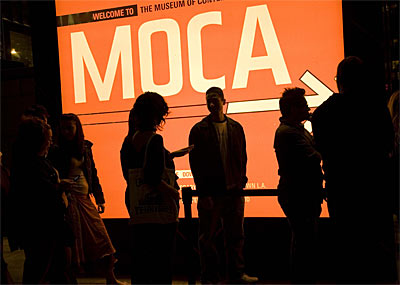
MOCA in financial crisis

Yesterday’s New York Times reported on the budget crisis looming at the Museum of Contemporary Art in Los Angeles, one of the most important centres for contemporary art on the west coast of the US:

The museum has operated at a deficit in six of the last eight years, and its endowment has shrunk to about $6 million from nearly $50 million in 1999, according to people who have been briefed on the finances.

Now the California attorney general has begun an audit to determine if the museum broke laws governing the use of restricted money by nonprofit organizations. And local artists, curators and collectors, including current and former board members, are lobbying to remove the museum’s director, Jeremy Strick, its board, or both.

The museum’s tailspin has brought an outpouring of grief and disbelief in a city that has recently cast itself as a rival to New York as the nation’s art capital. The closing of such a respected museum, or even its merger into another institution, would leave a formidable hole not only in the city’s psyche but in the national cultural landscape as well.

(read the rest of the article)

The philanthropist Eli Broad wrote an opinion piece in the LA Times in November offering $30 million to the museum, if his donation could be matched by other donors– but so far, no bites. The LA Times’ arts blog CultureMonster has been keeping tabs on developments, with interesting comments from the blogosphere following quickly on its heels. Will this be the first major museum to face closure in the economic downturn?

Internship opportunities for young cultural policy researchers

praxis

Dig policy in a serious way, and looking to get experience internationally? Does the mere mention of ‘Brussels’ send a shiver of pleasure down your spine? The European Network of Cultural Administration Training Centres (ENCATC, of which we at UCD are members) have recently distributed a bulletin listing a number of internship/traineeship opportunities available across Europe. A sample:

  • Traineeship at the European Commission in Brussels
  • Cultural Diplomacy Latin America Internship in Berlin
  • Orchestral Tours Internship in London
  • European Commission Delegation to the UN in New York

See the bulletin for details of all opportunities and application information.

Arts & New Media conference

I’m back from the one-day seminar held on the arts & new media at Dublin Castle, sponsored by the Arts Council. It was a lively day full of interesting discussion and presentation– for me the best aspect was meeting others in the Irish blogging community, and hearing how various organisations in Ireland are utilising social media and other web 2.0 technologies in their work. Damien Mulley and Fearghus Ó Conchúir have already recalled their experience at the conference on their blogs. Others appeared to be blogging the conference live, but I haven’t yet found their sites or responses… in principle it’s an interesting idea, but sitting next to a blogger furiously tapping away during a presentation (or indeed surfing the web or checking email) reminds me of the kind of things we kick undergrads out of lecture for doing! A bit irritating, to be honest.

To my mind the discussions based around the opportunities offered by web-based media to organisations were more productive than those that focused on their potential within art practice. Also I have an interest in the deeper implications of web 2.0 on processes of social interaction and creativity within organisations, which were addressed sporadically but not with any particular rigour. That being said, the initial fiery exchange between keynotes Andrew Keen and Charles Leadbeater was particularly enjoyable owing to the strong feelings and ideas it provoked. Leadbeater’s boulder and pebble metaphor seemed to resonate particularly well and was repeated by others throughout the day, but I suspect many in the audience found themselves surprisingly in sympathy with Keen’s point of view. I myself am concerned about the overly American-centric view of the world presented by web 2.0 utopians, and worry about the social inequalities and new hegemonies it tends to gloss.

In terms of the ‘open’ sessions, I was a bit disappointed to realise that they had been predetermined, and not left open for participants to decide, as in true Open Conferencing style. I suppose this is more achievable in a 2-day conference environment, but given the unusual diversity of attendees it felt like an opportunity not seized. Finally, I would have loved to have seen policy addressed in a more concrete way, which the last session promised but did not deliver. I suspect many in the audience were not actually that interested in discussing policy (fair enough), and although I appreciate Andrew Taylor’s response to my question, I would have much preferred a response from the RTE and Arts Council reps on the panel, who are more familiar with the Irish policy context and the giant ‘boulders’ in that arena. So much of the conversation on the day seemed to need more time– it often felt like folks were just getting started before it was time to move on to the next session! Clearly there’s a high level of enthusiasm out there for the subject, and I’ve heard from several people disappointed there was no space for them to attend (though they plan on catching up on the streaming audio).

I find it difficult to criticise any new initiative, mostly because I’m so delighted anything’s been done at all! Indeed the large turnout to the event is testament to the hunger for these conversations, but I also think it led to the conference ‘vibe’ feeling somewhat diffuse and unfocused. That’s a personal response of course– but I think the most productive work at these events gets done when a smaller group of participants are united around a central agenda and set of concerns, though their views, approaches and experience may differ. I hope a more concentrated series of events or get-togethers will emerge out of this first effort, and that the dialogue begun yesterday will translate into a more vibrant online arts community in Ireland.

Finally a big kudos to Annette Clancy and her team who put the whole event together– well I know the difficulty in managing such an event, and it was superbly organised and run.