Wednesday round-up (3 November 10)

This week’s digest:

  • A new iteration of the RDS Art Fair makes its debut on Friday 5th November (running until Sunday). Although usually catering to popular tastes, the Fair is including this year the Collective Contemporary Art (CCA) programme in the Industries Hall, which adds an interesting curated exhibition of selected contemporary artists to the mix.
  • CIRCA has debuted its first totally online issue, themed on the subject of ‘criticism and criticality’. I will miss the glossy (alas, the glossy screen is a reluctant substitute).
  • Today saw the launch of the first of a series of reports on the state of fundraising in Ireland (authored by 2into3 consulting in conjuction with Mason Hayes Curran. Unfortunately few arts organisations were included in the study, and it isn’t available online yet, but it should yield some interesting insights…
  • A seminar on the ‘Cultural Dimensions of Innovation‘ is being held by UCD at Newman House on St Stephen’s Green on November 15th & 16th, that will ‘analyse the cultural dynamics which will shape Ireland’s economic, technological and political innovation agenda’ (natch). No doubt terms like ‘creative economy’ and ‘cultural interfacing’ will be trotted out; let’s just hope this doesn’t happen.
  • Finally, the Arts Council has announced its strategic approach for the next three years— lots to process there, but increased funding for marketing/audience development initiatives, the heightened importance of ‘value for money’ and ‘sustainability’, and the altering/concluding of some funding relationships are all signalled.
Wednesday round-up

Blog’s been quiet of late– it never ceases to amaze me how busy the autumn term is! So much crossing the desk these days, I’m going to try and offer a weekly digest on Wednesdays of what’s been making the rounds…

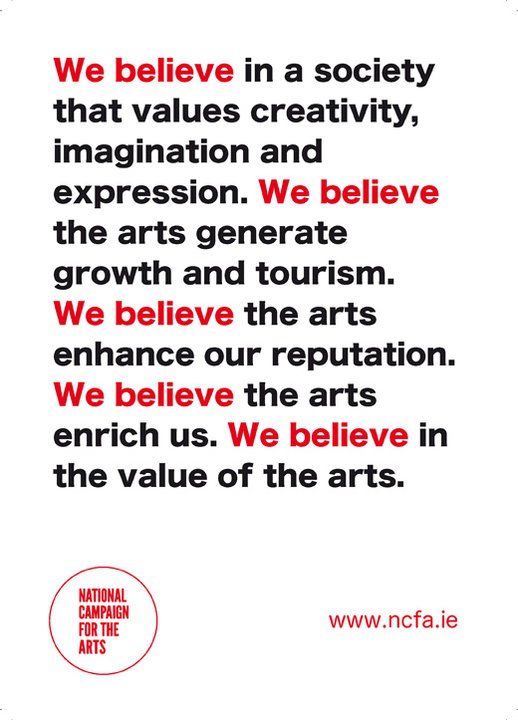
TODAY – National Day of Action – National Campaign for the Arts

After many weeks of preparation, the National Day of Action for the Arts is here!

What will you do today to add your support to the Campaign? There’s a whole range of events happening around the country, but here’s a few things you can do:

Whatever it is, do something!

National Campaign for the Arts – upcoming Day of Action

September 17th is the day to take part in the National Campaign For the Arts’  Day of Action— meetings will be taking place all over the country with local representatives and arts workers, to advocate for the ongoing support of the arts. As part of the effort, the NCFA has also produced a promotional video:

Here’s also a link to a recent interview on Morning Ireland. Lots more info is available on the NCFA site, but here’s a recap of the Campaign’s main objectives:

There is now a broad consensus that the arts will play a dynamic part in Ireland’s economic and social recovery. To maintain their role as a significant driver of employment, cultural tourism, the creative industries, our collective wellbeing and international reputation, NCFA asks that the next budget will:

(1) Maintain current levels of funding to the statutory agencies for the arts, including Irish Film Board, Culture Ireland and in particular The Arts Council, whose investment in the development of Irish artists generates the cultural assets that are central to our future.

(2) Make significant new funding available to the arts and culture sector to build on its cultural tourism potential, through the creation of a dedicated cultural tourism fund.

(3) Protect local authority arts funding and its essential role in the cultural diversity, social cohesion, economic impact, participation and identity of communities and regions.

Giving interns a fair deal

I read with great interest a recent report from the UK-based Institute for Public Policy Research (IPPR) on the subject of internships, employment law and ethics, entitled ‘Why Interns Need a Fair Wage‘. The report challenges the system of unpaid internships across the private and public sectors (including politics, business, law, media, fashion, the arts and non-profits), arguing that this structure:

  1. often violates UK employment law by denying interns minimum wage compensation to which they are legally entitled
  2. perpetuates inequalities in many professions by effectively denying entry to individuals without financial means to support themselves during long internship periods (3 mos-year, typically)
  3. further excludes people without family backgrounds in certain professions, owing to their lack of networks/contacts necessary to secure unadvertised but valuable internship places
  4. creates an ethical quandry for organisations who declare themselves to be pro-diversity and pro-access, whilst maintaining internship programmes that are exclusionary in nature

Continue reading