Backlash against British Council

hirst.jpg

Over 100 artists and arts professionals (including Damien Hirst, Tracy Emin, Nick Serota, David Hockney, Gilbert & George, etc) have signed a letter in protest over the apparent restructuring of the British Council’s arts programme, published recently in the Guardian. According to the accompanying article:

What is known is that the British Council is planning a radical shakeup in the way it delivers arts abroad, and part of that will entail scrapping its long-established arts departments, including visual arts, theatre, film and dance.

(see also the BBC‘s reporting of the controversy)

Meanwhile the British Council’s chief executive Martin Davidson has insisted in a statement that ‘the British Council remains deeply committed to the arts in all its forms. But like any organisation, we need to review our focus from time to time, and we are initiating such a consultation on the council’s arts strategy this month.’

It’s not yet clear what the restructuring will entail, but the claimed ‘consultation’ seems to be an exercise in optics rather than a true dialogue, as subsequent letters to the Guardian on the issue seem to indicate.

It’s been a tough week for the arts in Britain– in response to the recent major cuts by the ACE (as noted in a previous post) a number of theatres and orchestras in the UK are preparing to sue the Council for their loss of income. As Mark Brown of the Guardian observed:

… the artists are in revolt. The actors’ union, Equity, passed a vote of no confidence in Arts Council England, although it is implementing a much bigger than expected spending round. But while it is increasing money to three-quarters of its 990 regularly funded organisations, it is also cutting it for 194 of them. Sometimes the Arts Council must take tough decisions to allow innovative groups more money and refresh the pot with new organisations. But the actors believe theatre is taking too big a hit. Now the painters and sculptors are flexing their muscle against the British Council. What should have been a week for forward-looking debate on the arts has ended in acrimony and a breakdown in trust between artists and arts managers.
New Director for the Met?

The arts wires are buzzing with speculation on who will succeed the directorship of the Metropolitan Museum of Art… The Wall Street Journal carried an interesting article on the unusually high number of U.S. museums currently hunting directors (21), and the seismic shift in the role of the position since de Montebello took up his post in 1977. According to the WSJ:

Mr. Montebello’s decision comes at a time when the once-tweedy position of museum director is growing increasingly complicated. The industry as a whole is grappling with reduced federal and corporate funding of the arts, along with several years of flat attendance.

Museum directors have responded by boosting their fund-raising efforts and adding a slew of audience-friendly offerings like museum cafés, gift shops and curator-led vacations. But museum experts say the daunting job description — a mix of executive, lawyer and diplomat — has spooked some curators from signing up to direct; others have left for higher-paying jobs at auction houses.

Still, with the current director salary at $4.7 million and the kudos that comes with heading up one of the world’s finest art museums, there’s bound to be some interest! More also on this from the New York Magazine and an opinion from the WSJ

End of a legacy

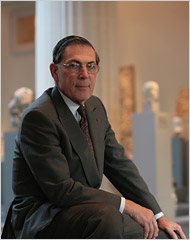
monte190.jpgThe New York Times today announced the impending retirement of Philippe de Montebello from the directorship of the Metropolitan Museum of Art, a post he’s held to great acclaim for over thirty years:

A patrician figure whose mellifluous multilingual voice on the museum’s audio guides is known to millions of visitors around the world, he is the eighth and longest-serving director in the institution’s 138-year history.

Mr. de Montebello, 71, has more than doubled the museum’s physical size during his tenure, carving out majestic new galleries suited to the Met’s encyclopedic holdings. Today it is the city’s biggest tourist attraction, with millions of visitors a year.

In its own way, his retirement marks the end of an era in the art museum world, where the aristocratic image of a museum director has become somewhat of an anachronism. As an intern at the Met a decade ago I met de Montebello, and recall the odd contrast between the interns’ casual (even grubby) cheerfulness and the director’s rounded tones! Nevertheless, not all is change within the museum world: it’s striking to note the complete absence of women in the NY Times’ list of possible successors to de Montebello, especially given the extreme gender imbalance in most art history and arts management university programmes today…

A new paradigm for donating art?

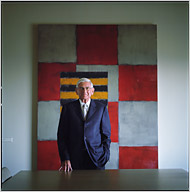
broad190.jpgThe Los Angeles County Museum of Art is putting a brave face on what must be a crushing blow for their acquisition hopes:

Eli Broad, the billionaire financier and philanthropist whose private collection of some 2,000 works of Modern and contemporary art is one of the most sought-after by museums nationwide, has decided to retain permanent control of his works in an independent foundation that makes loans to museums rather than give any of the art away. (more…)

Increasingly major art collectors seem dissatisfied with the restrictions and limitations slapped on to works once they’ve been given to museums, particularly the inability of museums to exhibit only a fraction of the works in their collection. The solution? Start your own museum, or in Broad’s case, devise an alternative model. From Broad’s point of view, the move ensures maximum exposure for his carefully assembled collection, as the foundation will be able to make loans to other institutions more flexibly and frequently than any single museum would. Yet moving control of artworks from public institutions to private foundations potentially carries serious long-term consequences, especially as the number of new privately-funded museums multiplies. One of the strengths of the museum setting is the ability to study and see works in context with one another, to create relationships through display and exhibition– goals that can also be reached through Broad’s model, but one wonders about the fundamental distance (practical and in principle) between works held in the public trust and those which remain stubbornly part of a single individual’s legacy…

Update: Read on for reaction from Christopher Knight in the Los Angeles Times, whose opinion on the move is summarised by his quote from Richard Lacayo’s Time Magazine blog: “LACMA got screwed.”

If the Turner Prize isn’t your bag…

… Jonathan Jones in The Guardian has a few suggestions for you:

moona_lisa.jpg

Who’s buying these Old Moosters?
Jonathan Jones
Monday December 3, 2007
The Guardian

The truth is very few people really like art. This is the dirty secret that makes a living for artists such as Caroline Shotton. She is a new addition to that august company of artists who have careers, it seems, solely on the back of the joy the public takes in upsetting art critics, especially at Turner prize time.The hilarious gimmick of this Central St Martin’s-educated painter is to put cows in the classics. She’s done the Mona Lisa as a cow and turned The Scream into The Moo. Klimt’s The Kiss becomes The Smooch and Cow with a Pearl Earring is her take on Vermeer. Breezily painted, big-eyed bovine faces whose blocky good humour would be diverting on a birthday card stare back at you from lurid pink and blue canvases.

Shotton, who started out as a commercial artist and took up her current, er, more personal and creative approach after having her first child, is typical of the new breed of artist who thrives on today’s market anarchy. Her works sell in limited-edition prints on block canvas through local dealers and online art stores at up to £600 a time; this has been touted as totalling £3m in sales. Just as the combination of affluence, the internet, and the rejection of lofty cultural standards by the art world has made stars of Jack Vettriano and Banksy, it has enabled Shotton to accumulate enough sales and attention to be promoted as the latest bad-taste popular artist. And I sympathise, I really do, if you’re reading this and siding with her for slapping the art snobs’ faces. Critics and museums lie when they claim serious art is accessible. It is obscure and demanding. The most worthwhile art improves when studied repeatedly and some simply refuses a casual glance, as Sir Joshua Reynolds recognised when he warned young artists that they wouldn’t get too excited the first time they saw a Raphael – they must persist until they liked him. Who has time for that now?

High art is no easier to understand, no more transparent, than classical music – and no less rewarding. But while classical music occupies its own separate cultural sphere, and if you don’t want to listen you don’t have to, art gets in your face. You feel you have to go and see King Tut or the Turner prize – and come away so bored and alienated you get your revenge by buying a print of Shotton’s Moona Lisa.