‘It’s me, me and me’: Damien Hirst on Hirst

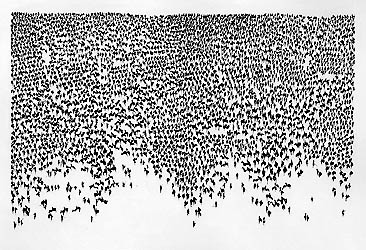
In anticipation of Damien Hirst’s monster car boot sale at Sotheby’s (Beautiful Inside My Head Forever), a number of profiles and articles have reflected on his status as ultimate art world celebrity (and his ballsy move of cutting out his dealers the Gagosian Gallery and the White Cube). The New York Times detailed the lengths Sotheby’s has gone to in preparation of the well-heeled, who will supposedly flock like dead bees to the honey:

Sotheby’s reinforced its floors to show Mr. Hirst’s dead animals. (The calf weighs 10 tons.) And it hired the New York architect Peter Marino to transform a rabbit warren of tiny back offices into a suite of rooms for V.I.P. buyers, with polished mahogany doors and walls lined with Mr. Hirst’s butterfly paintings. The space resembles a five-star hotel; several rooms have fireplaces and all are equipped with flat-screen televisions to allow buyers to watch the sale live and secretly bid by telephone.

Robert Hughes in the Guardian, however, is nothing if not critical:

If there is anything special about this event, it lies in the extreme disproportion between Hirst’s expected prices and his actual talent. Hirst is basically a pirate, and his skill is shown by the way in which he has managed to bluff so many art-related people, from museum personnel such as Tate’s Nicholas Serota to billionaires in the New York real-estate trade, into giving credence to his originality and the importance of his “ideas”. This skill at manipulation is his real success as an artist. He has manoeuvred himself into the sweet spot where wannabe collectors, no matter how dumb (indeed, the dumber the better), feel somehow ignorable without a Hirst or two.

Continue reading

The great man speaks on greatness

Event Announcement:

Irish Museums Association Annual Lecture

with Philippe de Montebello

National Gallery of Ireland, Lecture Theatre

20 November 2008 6.30 pm

The IMA Annual James White Lecture will be given by Philippe de Montebello, Director of the Metropolitan Museum of Art, New York, on the theme ‘What Makes a Great Museum Great’.

Admission Free. Booking is strongly advised.

For bookings, please contact the IMA office in 01 6633579 or ima@ngi.ie

Getting your Fringe on

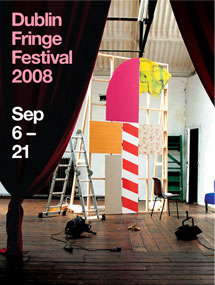
My highlight of the autumn kicks off with the Fringe Festival launching this Saturday! Over the years I’ve seen lots of productions, from brilliant to disastrous (more of the former and less of the latter), but I’m really excited this year about the staging of events in the Iveagh Gardens and the programme of street theatre (especially the opera Bastien and Bastienne). It’s Wolfgang Hoffman’s swan song after four years of running the festival, and the lineup looks like another stellar mix of theatre, dance, visual art and music.

MA programme alumnae Jenny Jennings is Programme Director for the Fringe and was interviewed in Saturday’s Irish Times about the upcoming festival and its drive to highlight new Irish talent:

Programme director Jennifer Jennings says that the strength of this year’s Irish element of the programme is more than accidental. It is a strategic part of Dublin Fringe Festival’s development over the past few years, and one that both Jennings and the festival’s outgoing artistic director, Wolfgang Hoffman, have been committed to fostering.

“We work as a platform for new artists,” Jennings explains. “I suppose you could say we are a producing partner, giving support ‘in lieu’ to emerging artists – from inviting them to use office facilities to giving them a place in the festival programme to, more recently, providing workshops for developing work.”

(yay Jenny!)

The Fringe website looks great too, with blogs and reviews (although it’d be great if they’d add an rss feed). This year tickets can be purchased from Filmbase and the Iveagh Gardens box office located on Hatch Street– the full programme pdf can be downloaded here.

Berlusconi tampers with Truth

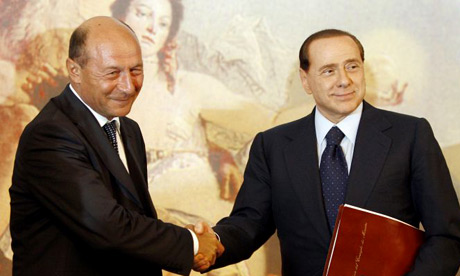
In other fascinating, hilarious yet somewhat disturbing news: minions attached to Italian prime minister Silvio Berlusconi have taken the initiative to cover up the nipple of a nude figure (‘Truth’) in a reproduction of a Tiepolo painting which hangs behind the minister during press conferences, as reported in the Guardian:

Slap in the middle of the painting is a neat, round female breast. During press conferences, as a commentator writing for the daily La Stampa noted, the breast floats above the prime minister’s head “like a halo”. This, it was felt, was too much for the sensibilities of a nation that – long before Berlusconi came along – had been feasting its eyes on half-naked Magdalenes and Minervas, not to mention the blatantly erotic statuary of Antonio Canova. Tiepolo’s breast, with attendant nipple, had to go.

Photos taken of the most recent press conference at Palazzo Chigi show the central figure has been retouched. An extra fold of clothing has appeared that covers the offending breast.

Berlusconi’s chief spin doctor, the junior minister Paolo Bonaiuti, told Corriere della Sera it was “an initiative of those on the staff of the prime minister who take care of Berlusconi’s image”. He went on: “That breast [and] that nipple ended up right in the shots the news bulletins used [for coverage of] the press conferences.”

He added that the prime minister’s image advisers feared that such a sight might offend the sensibilities of some television viewers.

Continue reading

IMMA’s collections in crisis

Part of the Tain tapestry series by Louis le Brocquy, one of the works currently suffering from poor storage conditions

A Tain tapestry by Louis le Brocquy, one of the IMMA works suffering from poor storage conditions

IMMA’s storage crisis made the front page of the Irish Times over the weekend, as a report obtained by the IT through Freedom of Information detailed the extent of damage that’s been done to the permanent collection due to inadequate storage facilities. This is the second revelation in recent months of serious mismanagement of national collections (following a damning audit of the National Museum’s collections by the Office of the Comptroller and Auditor General). The five-year-old IMMA report, authored by collections curator Catherine Marshall, details buckling of artworks, prints adhering to glass, and bloom appearing on metal sculptures– such damage making the works in storage ‘dangerous to handle’ unless absolutely necessary.

A second piece in the IT continued the IMMA story further:

Imma’s own on-site stores at its home at the Royal Hospital Kilmainham (RHK) were crammed with artworks, constituting a serious hazard as they could not be evacuated in the event of a fire and had no proper environmental controls to protect fragile works of art. With well over 1,000 works in its permanent collection by then, the vast bulk was being housed in “temporary” and “interim” warehouses and stores sourced off-site by the Office of Public Works (OPW), none of which were really suitable for storing art.

So critical had the storage situation become that Imma was forced to store works in a shipping container in the car park. The use of the shipping container was described as an emergency solution. But the “emergency” lasted four years. In September 2007, Imma’s director Enrique Juncosa wrote to Sean Benton, the chair of the OPW, again highlighting its storage problems.

Continue reading