Gloomy days for the arts

It’s feeling cold out there, and not just from the dusting of snow outside this morning.

Continuing on from Friday’s post, this morning’s Irish Times carries two more articles on the effect of the Arts Council’s funding cuts on theatre and music. Peter Crawley reports on the closure of three small production companies (Galloglass, Storytellers and Calypso) as a consequence of the new strategy to cull organisations perceived as artistically weaker from the AC trough, while maintaining funding for the biggies. This predictably has met with mixed reaction, which Crawley (to his credit) fairly assesses, noting that the slippery criterium of ‘artistic excellence’ has served as the fulcrum for artform funding decisions:

There is more sense in the strategy than some would care to admit though. A couple of years ago, during Theatre Forum’s annual conference, one of the best attended and breathlessly titled discussions was: How do we Approach the Issue of Encouraging the Arts Council to Cut Companies Who are ‘Past It’ to Enable New Talent to Breathe?

With the economy then going strong, but arts funding forever in short supply, theatre companies themselves harboured the suspicion that there were simply too many of them to sustain, and that the council was notoriously slow to cull the panjandrums. Now the problem is deciding who’s ‘past it’.

Not an enviable position for David Parnell of the Arts Council, partially tasked with making such artistic evaluations:

The Arts Council will not discuss individual cases with the media, but David Parnell admits that artistic quality is the ultimate measure. In the case of de-funded companies, he says, “ultimately the work is not as good as the work being offered by other organisations, and in the context of shrinking budgets we have to take these difficult decisions . . . Fundamentally, it comes down to the quality of the work offered and the ambition of the work.”

There are familiar complaints as well about the lack of transparency concerning decision criteria and a flawed appeals policy, as well as the interesting suggestion that the shrunken funding pool may push forward a new model for theatre production, away from the company model and towards a new ‘hub’-like structure. Well worth a read…

Michael Dervan offers another take on the harsh economic climate for the arts, revisiting the music cuts which have already been well covered by the IT (Opera 2005 in particular), but mentioning also the anticipated drop in corporate sponsorship:

The nightmares that the banking sector is living through will have consequences for the arts too. Sponsorship and other forms of corporate generosity will be reined in. One of the major musical sponsorships of recent years has been Anglo Irish Bank’s support of the RTÉ National Symphony Orchestra’s subscription series at the National Concert Hall. RTÉ has always given the impression that Anglo Irish managed to strike a happy balance between the supportive and demanding sides of sponsorship, meaning that the bank’s profile in the deal was clear but not obtrusive. Although the sponsorship was a long-term one, it was reviewed – and hitherto renewed – on an annual basis.

However, with the bank in a crisis that has led to its nationalisation, the sponsorship deal, believed to be worth six figures, may not survive assessment in the light of the new realities.

More on this on a forthcoming post, which will review two new reports recently released on philanthropy and sponsorship in Ireland…

Funding cuts in the arts: opportunity knocks?

An interesting article by Mick Heaney appeared in the Sunday Times on Jan 25th, calling on arts organisations to become more creative in their approaches to funding in a climate of recession (apologies, no link seems to be available!). While I would agree with some of the article, especially his suggestion that arts organisations need to diversify their income in order to better weather recessions, I would take issue with some of his points:

(1)

First is his use of statistics to highlight areas of the arts sector worst hit by the Arts Council recent budget cuts: when it comes to numbers and percentages, it’s easy to arrive at a multitude of conclusions to suit one’s own argument. Heaney asserts that theatre suffered the largest cutback (-12.7%), but he is including in his numbers The Abbey’s funding (which distorts the picture, as they are on a separately-assessed funding track)– whereas Deirdre Falvey in the Irish Times in December had come up with dance as the worst hit (-11%), followed by literature (-9.5%, a significant part of this owing to the axing of the Irish Writer’s Centre annual grant), and finally theatre, less the Abbey’s data (-8.37%). Although this is perhaps a minor point, it’s easy for such numbers to be manipulated, and such figures should be reported carefully. I also frequently see articles on the arts making claims using absolute statistical data, rather than adjusting numbers for inflation to arrive at their real equivalent– not so much an issue when the gap is a year or two, but significant when discussing growth/decline over a decade.

(2)

Second is his statement (which reads as a criticism):

The most obvious legacy of the boom years is the stratum of administrators who run the sector. While such professional expertise may be necessary to run companies efficiently, their support role has increasingly been placed at the heart of the arts sector: few organisations are contemplating laying off the backroom staff; the need to preserve professional experience is a mantra that pops ups repeatedly.

The problems with this are threefold: one, what basis is there for stating that managers’ support role has increasingly been situated  ‘at the heart’ of the arts sector? Again this seems a subjective claim; I might equally counter with the argument that the Arts Council has increasingly swung back towards grants for individual artists (as Heaney himself points out), the culture of arts managerialism is far less developed here than in the UK or the US, and if arts managers in the past few years have seemed more numerous, that’s probably due to the growth of the arts sector overall in the country, not their displacement of creative folks within organisations. Also, Heaney makes quite clear in the article that he supports the diversification of organisational income, to lessen reliance on government funding– and yet, this is the type of goal only achievable by the addition of managerial staff with expertise in marketing, development etc. Finally, as someone who manages an arts jobs webpage and has close contact with people entering the Irish arts workforce, I would suggest that while layoffs do not yet seem to be happening, there is a definite slowdown of new hires and staff turnover.

(3)

Third is his claim that ‘the increase in funding has not brought a similar upsurge of quality art (…) well-crafted but generic work… has dominated Ireland’s well-funded art sector’, and that the recession may offer ideal conditions for artistic innovation. Yet all of his examples are drawn from theatre– obviously the art form he knows best, but not a claim I would dare to make about the arts sector as a whole, let alone theatre (any views out there in agreement, or to the contrary?) What would Theatre Forum think? (WWTFT?)

However I do think it’s useful that the article contributes to the discussions happening now in response to cutbacks, as the Arts Council is forced to make tough choices. The responses for-and-against cuts to the Irish Writers Centre in particular (see Jan 13, Jan 15, Jan 17 and Jan 24 in the Irish Times) and the elimination for funding for Cork Opera 2005 (see 24 Jan and 27 Jan) can obscure the view that I share with Heaney: there shouldn’t be room for complacency in the arts sector, and those organisations, companies and artists who excel at what they do will survive and indeed flourish in spite of the downturn.

Swappin’ saliva in the name of art

As part of the Ulster Bank Dublin Theatre Festival, The Performance Corporation organised a flash mob theatre event in the ILAC Shopping Centre in Dublin last Saturday– over 100 actors took part– and a few by-standers! (check out the couple at 1:50)

Click on the video to see what happened…

Drama in Dublin

Acrobatic insects, nuns on dodgems, and chaos at the box office?

Yep, must be the Dublin Theatre Festival.

Currently in full swing, this year’s festival has had no shortage of drama off and on stage– from the cancellation of the preview performance of Black Watch (due to concerns about seating safety- ultimately unfounded), to a last minute re-seating scramble at the first night of Metamorphosis that delayed the performance for an hour or so. Nevertheless I think the programme at this year’s festival is one of the strongest in years, and every performance I’ve attended so far has been packed out…

It’s been interesting to read the reviews of the shows so far–  Fintan O’Toole dug Gatz but not Metamorphosis, Seona Mac Reamoinn found Dodgems ‘deliciously fun’ but still in need of ‘tinkering’, and Sara Keating called Between The Devil and the Deep Blue Sea ‘near perfection’.

On my scorecard, Dodgems was a clear winner, if at times heavy-handed with the social themes; England was great in the first half but floundered in the second; and Metamorphosis was uneven but had a very impressive performance from its lead actor. I’ve heard good things too about The Year of Magical Thinking and Hedda Gabler— and I’m looking forward myself to Cat on a Hot Tin Roof and Cripple of Inishmaan.

Any other thoughts out there on this year’s crop?

On a related note, in Saturday’s Irish Times Chris Morash reviewed the newly published edited volume Interactions: Dublin Theatre Festival 1957-2007, a look back at the development of the festival over the past five decades, and by extension, the growth of theatre in Ireland:

Based (in part), on a conference organised by the Irish Theatre Diaspora Project at last year’s theatre festival, the first part of the book brings together 14 essays by various theatre scholars on aspects of the festival, ranging from its foundations in the 1950s, to recent Russian and Australian productions.

The second part of the book lays the foundations for future research, by combining short (often entertainingly anecdotal) essays by former festival directors (Lewis Clohessy, David Grant, Tony O’Dalaigh, and Fergus Linehan) with a complete listing of all festival productions since 1957.

Sounds like a much needed dose of context and critique on Irish theatre– the book is published by Carysfort Press and is edited by Nicholas Grene and Patrick Lonergan.

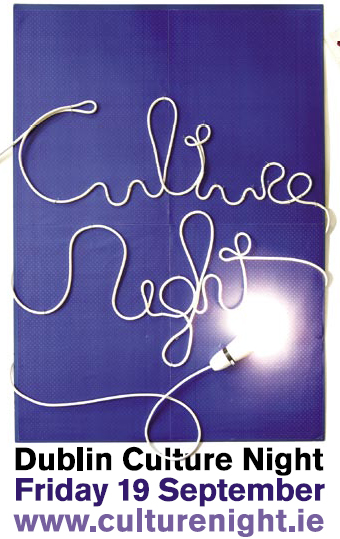
Culture Night 2008: this Friday!

Just a reminder to all you vultures out there– the third annual Culture Night takes place this Friday, September 19th, from 5-11 pm. In Dublin more than 100 arts & cultural organisations will be staying open late, offering unique & fun programming for this evening only. Temple Bar Cultural Trust is the driving force behind the initiative, which includes special bus routes (map pdf) laid on to take vultures from spot to spot, and lots of outdoor performances and entertainment.

It’s not just Dublin getting all the action either:

Culture Night Cork: http://www.corkcity.ie/culturenight
Culture Night Limerick: http://www.limerickcity.ie
Culture Night Galway: http://www.galwaycity.ie

Last year’s event had a great buzz to it– wandering around the National Gallery at near 11 pm was a surreal highlight for me!– and it’s a great chance to check out (for free!) sites that normally require admission. I’ve got a few circled already… 🙂

Copies of the programme can be downloaded as a pdf here, or picked up in print copy from participating venues, the Suffolk St Dublin tourist office, or Temple Bar Cultural Information Centre at 12 East Essex Street (the latter two will be open 9am until 11pm on Culture Night).