Irish Architecture Foundation website launch

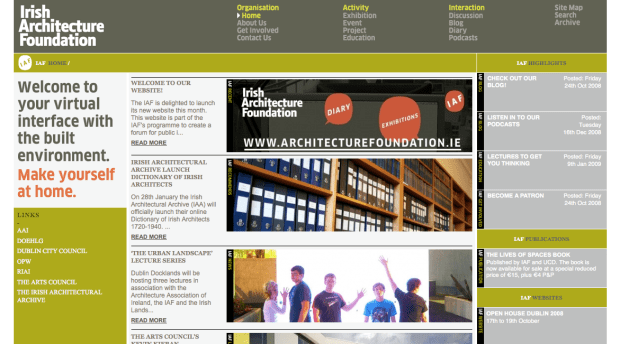
Irish Architecture Foundation website

On Friday the Irish Architecture Foundation launched its new website– very swish! Super design, rich content– it’s one of the best Irish arts sites I’ve seen. Podcasts, blogs, lectures through streaming video… it’s long been a pet peeve of mine how poorly many arts orgs use the web, but I’m delighted to see the IAF taking up the gauntlet. It’s a marvellous organisation, with wonderful programmes (Open House Dublin) and exhibitions (the latest Venice Biennale entry ‘The Lives of Spaces‘ was elegant and provoking)– and the new site sets it all off perfectly.

Ok, enough gushing, go check it out now for yourself…

Paul McGuinness not happy with the hippy

no-hippy.jpg

Yesterday the Guardian carried a fairly hilarious piece on U2 manager Paul McGuinness– who claimed during a music conference in Cannes that the entrepreneurs of Silicon Valley (namely Bill Gates, Steve Jobs, and their hippy kinfolk) should be Public Enemy #1 in the fight against illegal music downloads. As McGuinness informs us:

“Embedded deep down in the brilliance of those entrepreneurial, hippy values seems to be a disregard for the true value of music.”

Eh? Hippy slurs aside, this sounds like simply another episode of record company hand-wringing… publications like The Word magazine (see their February 2008 issue, unfortunately not available online) have more astutely (sorry Paul) captured the essential disconnect between the profit models of the industry, unstoppable technology, and the values of the music-loving public…

New Science Gallery launches with ‘Lightwave’ festival

lightwave.gif

The long-anticipated new Science Gallery at Trinity College Dublin will be launching in early February with the fantastic programme Lightwave (click here to download a programme pdf), running from 2-9 February. The festival offers a wide range of exhibitions and event on the theme of light, blurring the boundaries of science and art. Offerings include a fashion show, interactive games, films, a Volkswagon beetle covered with thousands of lights that will be patrolling Dublin city centre, and other happenings.. too many to list here! DO check out the schedule– this is something very unique that hasn’t been done in Ireland before, and it’s sure to be fantastic!

Innovation and the Irish museum

natmuseum.jpg

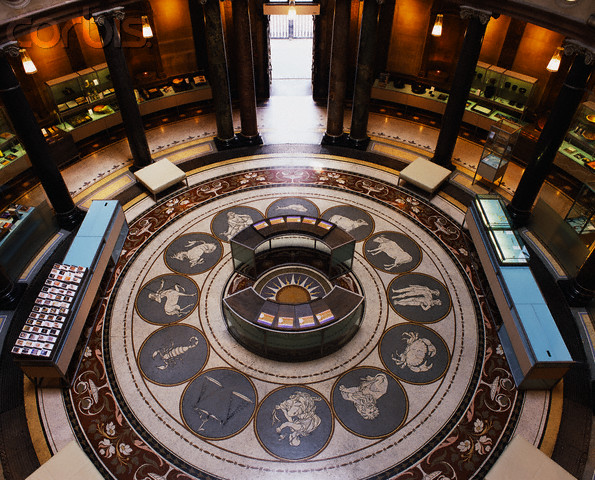
The weekend Irish Times carried an interesting article by Brian O’Connell on the slow pace of innovation at Irish museums– perhaps not a surprising conclusion to anyone who’s crossed their thresholds recently. With the Galway City Museum singled out for particular criticism, the article finds that despite some improvements, Irish museums lag pretty far behind their American and British cousins:

So, how do Ireland’s institutions compare with their international counterparts? Academic Pat Cooke admits there are challenges for Ireland’s museums, but says that some have already been quick to adapt and innovate in line with visitor expectations. “In general, the changes required have to do with museums consulting better with the public, finding out what people are genuinely interested in and putting on exhibitions that mean something to people,” he says.

Cooke highlights the Foynes Flying Boat Museum and the GAA Museum at Croke Park as examples of how Ireland’s museum sector has got it right. Others, he feels, are still too loyal to their archeological collections – with case after case of axes and flintheads doing little to inspire a new generation of visitors.

“The archeological mindset is the hardest one to crack,” says Cooke. “Like it or not, 90 per cent of people couldn’t care less about axeheads. Museums need other types of mindsets, other than purely archeological, to enable people connect on various levels.”

Lack of funding, of course, is the perennial scapegoat– yet it’s questionable whether such stagnation is solely the consequence of small budgets. Though it may be a controversial assertion, the leadership of our national institutions is not what it could be: saddled with a bureaucratic legacy and offering little in the way of fresh leadership perspectives, our museums have been sluggish in adopting new technologies and approaches now commonplace at other institutions. One look at the websites of the national institutions is very revealing… Flash? Podcasts? Interactivity? The room for improvement is tremendous…

Annaghmakerrig gets wired: ArtLog at the Tyrone Guthrie Centre

guthriecentre.jpg

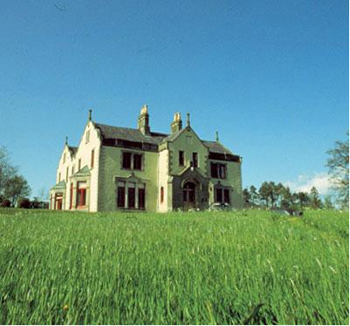
The Irish Times reports today on an unusual new initiative to be launched at the Tyrone Guthrie Centre in Annaghmakerrig, Co. Monagahan. ‘ArtLog’– developed at the Digital Media Centre at Dublin Institute of Technology–has been designed to record information about artists who visit the retreat centre, forming a kind of ‘personal archive’ of their activity during their stay.

Every artist who checks in at the centre will be asked to supply basic biographical information for the central database. After that, participation in the digital archive will be optional – artists who elect to participate will also be able to choose whether to record their thoughts, ideas and methodology in a blog-style journal, an audio recording or a video diary.

Director Pat Donlon views the project as simply an updated version of the artist’s note or sketchbook– another means of capturing what is otherwise often ephemeral material:

“This is the age of the finished product,” she says. “We see paintings appear in galleries as if they just leapt on to the canvas fully formed; books appear, but the author’s draft versions of the manuscripts simply disappear. It’s becoming more and more difficult to capture the process of creativity. Nobody writes letters any more. They write e-mails, but nobody archives their e-mails. What will be left for scholars who come along in 20, 23, 40 years time, wanting to inquire into the thought processes of a particular writer or visual artist? Nothing.”

“You know how upset we get when somebody close to us loses their memory, gets Alzheimer’s? The pain and grief around that is enormous,” she says. “Well, we’re talking about our cultural memory here. If Irish art is a mosaic of little pieces, we have to keep all those pieces. And the tiny pieces are as important as the big ones because they hold the whole thing together.”

Sounds intriguing, but I’m less convinced by the argument that artists’ processes are less documented today than they have been in the past! If anything, we live in an age of paranoia about the loss of memory and information, paradoxically at a time when more of it is available than ever before. In any case it will interesting to see whether the new technology is taken up by the Centre’s resident artists and writers, and if anything useful will emerge.