New Media Mentoring Scheme – reports published

Arts Audiences is an Arts Council and Temple Bar Cultural Trust- sponsored initiative aimed at supporting & delivering audience development projects in cooperation with various arts & cultural organisations.

One of their programmes is the New Media Mentoring Scheme, which has just published a series of reports from the mentor/mentee relationships, which included:

  • John Tierney of Google Ireland mentored Conor Malone, General Manager of Balor Arts Centre (using Google AdWords)
  • A team from Google Ireland mentored Tara Connaghan Artistic Director of Éigse Carlow Arts Festival (using Google Ads and Google Analytics)
  • A team from Google Ireland mentored Michelle Dillon, Marketing Officer of The Dock (balancing time and resources spent on website and on social media platforms)
  • A team from Google Ireland mentored Derek Kelly, Box Office Manager of The Gate Theatre (increasing traffic to website)
  • Aoife Flynn of asquared mentored Rayne Booth of Temple Bar Gallery & Studios (developing a website brief)
  • Lucy Campbell and Muire Laffan of RTÉ Publishing mentored Emmet Sheerin and Anne O’Gorman from NYCI (developing web strategy)
  • Aoife Flynn mentored Marcella Bannon of Droichead Arts Centre (developing digital marketing strategy)

I was particularly interested to read the reports of Michelle, Rayne and Emmet, all (relatively) recent graduates of our MA programme. It sounds like some very valuable reflections and progress was made as a result of the collaborations; for example:

Continue reading

iPhones/Droids at the ready: CMC’s Music Trail in our fair city

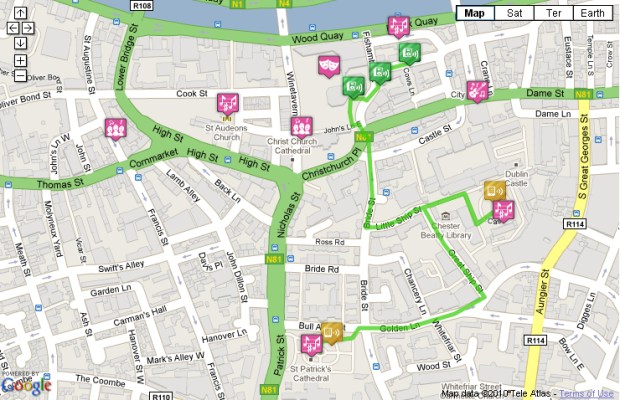
Three cheers for the Contemporary Music Centre’s innovative new Music Trail, which will be launched in a few days’ time, and run from 21 August-1 September!

The Outdoor Music Trail features works by different Irish composers playing in five outdoor locations; an inner trail with three locations playing music outdoors daily from 1pm to 4pm and an extended trail incorporating the first three locations, plus two additional locations which can be followed and listened to with a smartphone. The extended trail employs the very latest in location-based, augmented reality technology and is available by downloading the free Layar app for iPhone 3GS, iPhone 4 and Android devices.

Sounds intriguing, especially the ability to stream the music at any point during the Trail’s run… will have to go check out the ‘live’ versions between 1-4 as well.

The Music Trail is also the first event to be launched under the leadership of the CMC’s new director Evonne Ferguson, who no doubt will continue the CMC’s tradition of fine programming and commitment to contemporary music.

‘Arts Audiences’ new site launch & upcoming web 2.0 event

arts_audiences

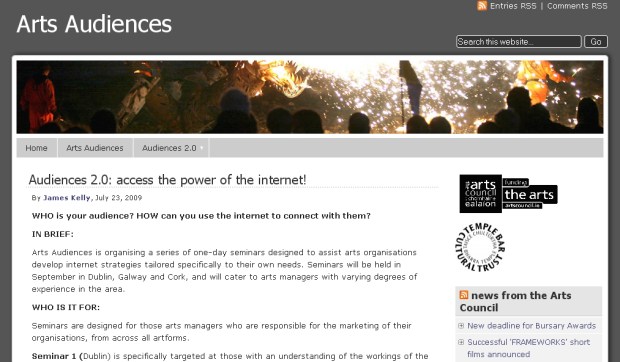
The Arts Council, in collaboration with Temple Bar Cultural Trust, has rolled out a new site focused on Irish arts audience development, www.artsaudiences.ie.  Here’s the skinny on their rationale for the initiative:

  1. Attendance and consumption; attendance for some artforms is falling; we need to increase the frequency with which people come to, for instance, our venue or festival and we need to keep people coming back year-on-year.
  2. Customer service and experience; customers care about more than just the show or event and we need to see what we can do to make sure their experiences are good ones
  3. Working together; arts organisations should collaborate more to speak to and attract audiences
  4. New media; All of us need to know more, to help us take advantage of the opportunities which a new media landscape have brought. We recognise that organisations operate at different levels of online activity and will strive to reflect this as we address this.
  5. Information; we need to address the gaps in our information about audiences – who they are and how they behave. Figuring out what we need to know is a key step in figuring out what to do.

(see the full manifesto here.)

Plans so far include:

  • A low-tech no-cost project where arts organisations will recommend each others work and we will report on what worked and what didn’t
  • A large-scale national promotion of the performing arts for a period of time in the autumn

Future plans include online resource material, and new training & mentoring programmes.

More imminent, however, is a series of one-day workshops on Web 2.0 and audience development to be offered in Dublin, Galway and Cork in September. They’re looking for registration ASAP, unless the slots have been filled already… it’s only €45 for a full day session, and looks to be a promising build on the excellent Arts Council-sponsored New Media & the Arts conference held last November.

  1. Attendance and consumption; attendance for some artforms is falling; we need to increase the frequency with which people come to, for instance, our venue or festival and we need to keep people coming back year-on-year.
  2. Customer service and experience; customers care about more than just the show or event and we need to see what we can do to make sure their experiences are good ones
  3. Working together; arts organisations should collaborate more to speak to and attract audiences
  4. New media; All of us need to know more, to help us take advantage of the opportunities which a new media landscape have brought. We recognise that organisations operate at different levels of online activity and will strive to reflect this as we address this.
  5. Information; we need to address the gaps in our information about audiences – who they are and how they behave. Figuring out what we need to know is a key step in figuring out what to do.

Publicart.ie launched – some notes

publicartie

The long-anticipated site www.publicart.ie has recently launched. Sponsored by the Arts Council and DAST, the site’s aims include:

Vision
•    To build a solid body of information and knowledge on public art practice
•    To place public art within a critical context
•    To provide information on commissions, projects and news
•    To develop a growing directory of commissions, projects and artworks
•    To provide a curatorial approach to mapping public art practice
•    To support information exchange, debate and news from the field
•    To offer information on commissioning procedures
•    To provide a space for new on-line artworks

I’ve been waiting for this site to launch for some time, especially given that I teach on some aspects of public art here at UCD. The site does have some good information on about 60 different projects, stretching acros the country. However the vast majority of these were temporary, time-based or performative works. There’s very little by way of more ‘traditional’ public art– and I’m not clear how far back in time the site’s designers intend to go. As much of the content seems to be based on submissions from various project coordinators, it would appear that this is a tiny snapshot of public art in Ireland, and probably not the most visible segment of that sector either (which is both a good and bad thing!)  While it’s a great idea to give temporary projects added visibility (especially given that documentation can be hard to come by for such work), to neglect permanent art & sculpture (and any mention of the historical context of public art in Ireland) is a massive oversight. Additonally, I would expect to see on such a site links to excellent local authority websites and/or listings of regional public art, such as Donegal CC‘s efforts towards this end.

Most distressing from my own point of view, there seems to have been little consultation with the many academics on this island working on the subject of public art. While a few of the extracts on the ‘Writings’ section of the site are very interesting and influential (particularly Claire Bishop’s article on the Social Turn), most of the pieces here are journalistic in tone (or alternatively very shallow in terms of their research and scope), and include no reference to the many outstanding pieces of Irish academic writing and research on the subject (in both journal and monographic forms). This is not to suggest academics hold some kind of monopoly on commentary, but as I’ve worked myself in this area in Ireland for the last seven years and am aware of much current and recent research on Irish public art,  I do find their exclusion very puzzling. On a related note, the Library section is patchy and also primarily international (no mention of Judith Hill’s landmark book on Irish public sculpture, for example) and would benefit from a read of the various syllabi of university courses on public art offered at Trinity, UCD, UCC, NCAD and elsewhere. As the range of publications on international public art is vast, why not elect to focus on work here in Ireland (do we really need another link to Maya Lin)?

Perhaps the designers & administrators of this site might elect to circumscribe their project more clearly? If the intent is to focus on very recent,  ‘new genre’ (to borrow Suzanne Lacy’s term) public art, it would be more effective to note this. I don’t mean to be entirely negative about the site, as a centralised website on Irish public art is much needed and will prove valuable (especially to practitioners), given time and additional contributions. I also understand that this is a site in progress, without a dedicated administrative team (or so the website would suggest?), and is very much still evolving. I just can’t help feeling disappointed, given the great need to make information on Irish public art more accessible, web-based and richer in content and relevance.
The masses mass for Picass(o)

picasso-elite-460_1006484c

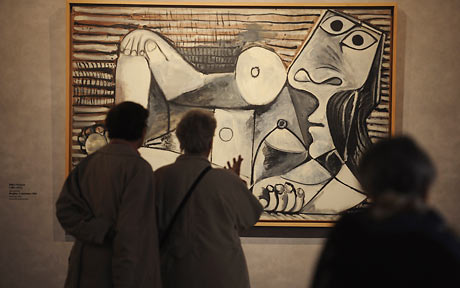
Having my daily breakfast of espresso and Euronews, I was amazed to see a story on the public response to the Picasso exhibition currently on at the Grand Palais in Paris… the show’s about to close, and tens of thousands of people apparently queued overnight to catch a last glimpse of the works. To facilitate the crowds the Grand Palais hosted a marathon 83-hour viewing session. According to the accompanying article on the Euronews website, more then 700,000 people have visited the exhibition since it opened in October.

And yet the spirit of liberté, égalité, fraternité has not graced all quarters, with detractors late last year describing the populist shows as ‘a cancer’ in the Parisian art world.

Elsewhere the arts democracy has gained stronger footing, as the BBC last Wednesday announced its intent to put 200,000 paintings in public ownership online, and the imminent appointment of a new arts editor and arts board to enhance coverage. This follows on too from the innovative move by the Prado in early January to place some of its greatest paintings on Google Earth in extreme high resolution, allowing online viewers to see the works in astonishing detail.

And yet, I can’t help but feeling a mixture of exhilaration and depression at such news… imagine an RTE arts board? The public queuing for hours to see a National Gallery exhibition? Irish paintings in the public ownership actually (gasp!) online? What happens to a dream deferred…