Mary Mac and Simon Wiesenthal Center spar over Nazi claims

hunt-museum2.jpg

During a visit on Monday to the Hunt Museum in Limerick, President Mary MacAleese criticised claims made by the Simon Wiesenthal Center concerning the provenance of the collection, and the description of the late Hunts as “notorious dealers in art looted by the Nazis”. Today the Irish Times reported on the SWC’s response to the president:

President Mary McAleese has been criticised by the Simon Wiesenthal Centre (SWC) for censuring it over allegations it made about the Hunt Museum. The centre said it would be publishing a report in five or six weeks’ time which would vindicate its stance on the issue.

The centre’s European director, Dr Shimon Samuels, said he was “quite shocked” at Mrs McAleese’s remarks, which were uncalled for and were “not very presidential and were very unstatesmanlike”.

(…)

Mrs McAleese said the allegations were “baseless . . . unfounded . . . a tissue of lies” and had hurt many people.

Last October, an independent report by Lynn Nicholas, a world authority on Nazi looted art, found that “the presently available information and research provides no proof whatsoever that the Hunts were Nazis, that they were involved in any kind of espionage, or that they were traffickers in looted art”. (more…)

UPDATE: Fintan O’Toole gives the President an earful on the issue in Saturday’s Irish Times

Colbert joins hallowed hall of U.S. presidents

colbert_small.jpg

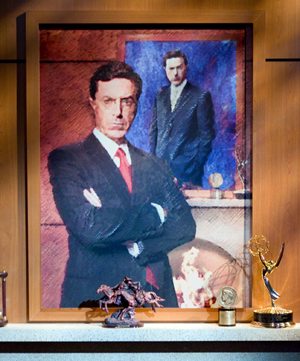
Fresh from the AP wire: Stephen Colbert, thwarted presidential contender and pundit-in-chief at the Colbert Report (and ex-Daily Show correspondent), has convinced the National Portrait Gallery in Washington D.C. to temporarily display his portrait ‘in what the museum considers an “appropriate place” — right between the bathrooms near the “America’s Presidents” exhibit’:

After the work was rejected by the National Museum of American History, Colbert eventually made his way to the portrait gallery. Bentley said Colbert wasn’t begging so much as “making his case.” She said they welcome the conversation about whose portraits are included in the gallery’s collection. It was just not Colbert’s time, she said.

“Who’s the competition? Who do I need to knock out of here to get me up?” Colbert asked gallery director Marc Pachter.

Colbert argued he was more deserving than athletes Lance Armstrong or Andre Agassi and pulled out his Hacky Sack for a few kicks in the art gallery to prove it. “You do realize I’m in big trouble if you hit any of these portraits,” Pachter said.

Still, Colbert said he thinks his “sack work” ultimately won Pachter over for the temporary display.

In this season of American electioneering and political bickering, it’s nice to see the Smithsonian taking a stand for freedom.

Innovation and the Irish museum

natmuseum.jpg

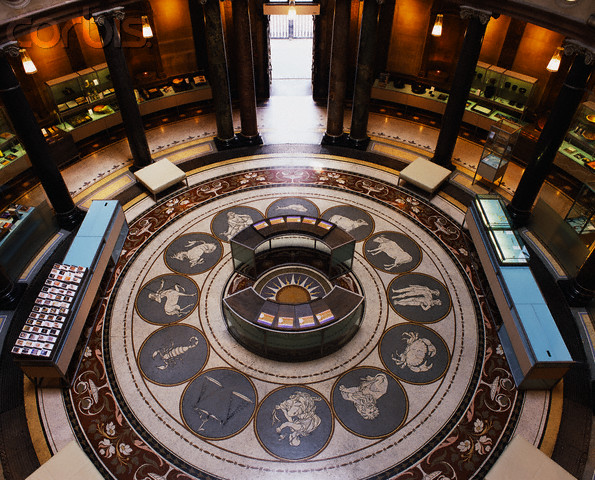
The weekend Irish Times carried an interesting article by Brian O’Connell on the slow pace of innovation at Irish museums– perhaps not a surprising conclusion to anyone who’s crossed their thresholds recently. With the Galway City Museum singled out for particular criticism, the article finds that despite some improvements, Irish museums lag pretty far behind their American and British cousins:

So, how do Ireland’s institutions compare with their international counterparts? Academic Pat Cooke admits there are challenges for Ireland’s museums, but says that some have already been quick to adapt and innovate in line with visitor expectations. “In general, the changes required have to do with museums consulting better with the public, finding out what people are genuinely interested in and putting on exhibitions that mean something to people,” he says.

Cooke highlights the Foynes Flying Boat Museum and the GAA Museum at Croke Park as examples of how Ireland’s museum sector has got it right. Others, he feels, are still too loyal to their archeological collections – with case after case of axes and flintheads doing little to inspire a new generation of visitors.

“The archeological mindset is the hardest one to crack,” says Cooke. “Like it or not, 90 per cent of people couldn’t care less about axeheads. Museums need other types of mindsets, other than purely archeological, to enable people connect on various levels.”

Lack of funding, of course, is the perennial scapegoat– yet it’s questionable whether such stagnation is solely the consequence of small budgets. Though it may be a controversial assertion, the leadership of our national institutions is not what it could be: saddled with a bureaucratic legacy and offering little in the way of fresh leadership perspectives, our museums have been sluggish in adopting new technologies and approaches now commonplace at other institutions. One look at the websites of the national institutions is very revealing… Flash? Podcasts? Interactivity? The room for improvement is tremendous…

New Director for the Met?

The arts wires are buzzing with speculation on who will succeed the directorship of the Metropolitan Museum of Art… The Wall Street Journal carried an interesting article on the unusually high number of U.S. museums currently hunting directors (21), and the seismic shift in the role of the position since de Montebello took up his post in 1977. According to the WSJ:

Mr. Montebello’s decision comes at a time when the once-tweedy position of museum director is growing increasingly complicated. The industry as a whole is grappling with reduced federal and corporate funding of the arts, along with several years of flat attendance.

Museum directors have responded by boosting their fund-raising efforts and adding a slew of audience-friendly offerings like museum cafés, gift shops and curator-led vacations. But museum experts say the daunting job description — a mix of executive, lawyer and diplomat — has spooked some curators from signing up to direct; others have left for higher-paying jobs at auction houses.

Still, with the current director salary at $4.7 million and the kudos that comes with heading up one of the world’s finest art museums, there’s bound to be some interest! More also on this from the New York Magazine and an opinion from the WSJ

End of a legacy

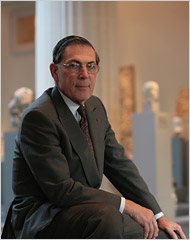
monte190.jpgThe New York Times today announced the impending retirement of Philippe de Montebello from the directorship of the Metropolitan Museum of Art, a post he’s held to great acclaim for over thirty years:

A patrician figure whose mellifluous multilingual voice on the museum’s audio guides is known to millions of visitors around the world, he is the eighth and longest-serving director in the institution’s 138-year history.

Mr. de Montebello, 71, has more than doubled the museum’s physical size during his tenure, carving out majestic new galleries suited to the Met’s encyclopedic holdings. Today it is the city’s biggest tourist attraction, with millions of visitors a year.

In its own way, his retirement marks the end of an era in the art museum world, where the aristocratic image of a museum director has become somewhat of an anachronism. As an intern at the Met a decade ago I met de Montebello, and recall the odd contrast between the interns’ casual (even grubby) cheerfulness and the director’s rounded tones! Nevertheless, not all is change within the museum world: it’s striking to note the complete absence of women in the NY Times’ list of possible successors to de Montebello, especially given the extreme gender imbalance in most art history and arts management university programmes today…