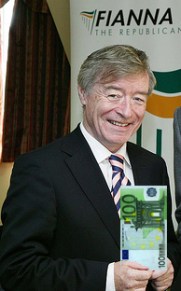
Brennan shows us the money

brennan.jpgThe Minister for Arts, Sport and Tourism yesterday unveiled the ‘Arts and Culture Plan 2008’ which includes details of funding available from the Department for 2008. The pledge of an additional €40 million towards increasing arts access and participation is included in Thursday’s announcement, along with a full listing of other allocations and initiatives.
Access is clearly the dominant issue: the extension of opening hours for National Institutions has been made a precondition of their increased funding; a new ‘National Cultural Day’ has been mooted; and the document states that as the Arts Council reviews its progress under the current ‘Partnership for the Arts’ plan ‘The Minister will issue a policy instruction to the Arts Council to request that … a strong emphasis is placed on the development of audiences, access to the arts, contemporary dance, choral music, access to musical instruments and actor training.’

The second major theme is probably investment into infrastructure and capital projects, including: support for the National Concert Hall extension, Abbey Theatre relocation, Collins Barracks extension, National Library extension, refurbishment of the Druid in Galway, extension to Gate Theatre, establishment of Irish Chamber Orchestra headquarters, new opera house for the Wexford Festival Opera, five new centres for Comhaltas Ceoltóiri Éireann, the refurbishment of the RHA, revival of the Smock Alley Theatre in Temple Bar, and of course the ACCESS programme.

Wherefore art thou Irish construction slow-down? Apparently not in the arts sector.

Continue reading

Backlash against British Council

hirst.jpg

Over 100 artists and arts professionals (including Damien Hirst, Tracy Emin, Nick Serota, David Hockney, Gilbert & George, etc) have signed a letter in protest over the apparent restructuring of the British Council’s arts programme, published recently in the Guardian. According to the accompanying article:

What is known is that the British Council is planning a radical shakeup in the way it delivers arts abroad, and part of that will entail scrapping its long-established arts departments, including visual arts, theatre, film and dance.

(see also the BBC‘s reporting of the controversy)

Meanwhile the British Council’s chief executive Martin Davidson has insisted in a statement that ‘the British Council remains deeply committed to the arts in all its forms. But like any organisation, we need to review our focus from time to time, and we are initiating such a consultation on the council’s arts strategy this month.’

It’s not yet clear what the restructuring will entail, but the claimed ‘consultation’ seems to be an exercise in optics rather than a true dialogue, as subsequent letters to the Guardian on the issue seem to indicate.

It’s been a tough week for the arts in Britain– in response to the recent major cuts by the ACE (as noted in a previous post) a number of theatres and orchestras in the UK are preparing to sue the Council for their loss of income. As Mark Brown of the Guardian observed:

… the artists are in revolt. The actors’ union, Equity, passed a vote of no confidence in Arts Council England, although it is implementing a much bigger than expected spending round. But while it is increasing money to three-quarters of its 990 regularly funded organisations, it is also cutting it for 194 of them. Sometimes the Arts Council must take tough decisions to allow innovative groups more money and refresh the pot with new organisations. But the actors believe theatre is taking too big a hit. Now the painters and sculptors are flexing their muscle against the British Council. What should have been a week for forward-looking debate on the arts has ended in acrimony and a breakdown in trust between artists and arts managers.

A new paradigm for donating art?

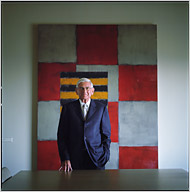
broad190.jpgThe Los Angeles County Museum of Art is putting a brave face on what must be a crushing blow for their acquisition hopes:

Eli Broad, the billionaire financier and philanthropist whose private collection of some 2,000 works of Modern and contemporary art is one of the most sought-after by museums nationwide, has decided to retain permanent control of his works in an independent foundation that makes loans to museums rather than give any of the art away. (more…)

Increasingly major art collectors seem dissatisfied with the restrictions and limitations slapped on to works once they’ve been given to museums, particularly the inability of museums to exhibit only a fraction of the works in their collection. The solution? Start your own museum, or in Broad’s case, devise an alternative model. From Broad’s point of view, the move ensures maximum exposure for his carefully assembled collection, as the foundation will be able to make loans to other institutions more flexibly and frequently than any single museum would. Yet moving control of artworks from public institutions to private foundations potentially carries serious long-term consequences, especially as the number of new privately-funded museums multiplies. One of the strengths of the museum setting is the ability to study and see works in context with one another, to create relationships through display and exhibition– goals that can also be reached through Broad’s model, but one wonders about the fundamental distance (practical and in principle) between works held in the public trust and those which remain stubbornly part of a single individual’s legacy…

Update: Read on for reaction from Christopher Knight in the Los Angeles Times, whose opinion on the move is summarised by his quote from Richard Lacayo’s Time Magazine blog: “LACMA got screwed.”

A big lump o’coal for some English arts organisations

funding_graph5050505.jpg

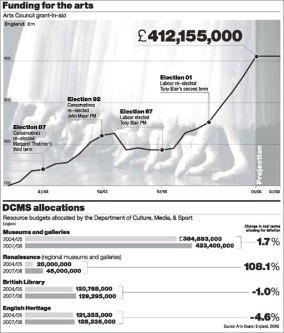
The Guardian reported yesterday on the Arts Council of England’s decision to axe funding for nearly 200 organisations, although a significant number will be enjoying large grant increases. Little comfort to the National Student Drama Festival, however, which looks set to lose its £52,000 grant in advance of its annual festival only a few months away…

With over £1 billion in their coffers, is the ACE’s decision savvy management or serious scrooging?:

The Arts Council admitted the pre-Christmas timing was bad, but said “tough decisions” had to be made. Its spokeswoman, Louise Wylie, said the criteria on which it was taking the funding decisions included access and breadth of audiences, and the excellence of work. The council has been taking decisions in tandem with a national review into excellence in the arts by Brian McMaster, former director of the Edinburgh International Festival. The government is expected to publish his report in January.

The news comes at what had been an atmosphere of good cheer in the arts after the Arts Council was given a higher than expected financial settlement by the government. But the council’s strategy is to hand out the money so that organisations can thrive rather than just survive. “In among the bad news for the minority, there is extraordinarily good news for the majority,” said Wylie.

It admits that there will be fewer organisations getting money, but points out that while 194 are seeing funding cut, another 80-odd are being added to its portfolio. (more)

More budget woes northside…

koaarally2.jpgThink the arts sector is underfunded in Ireland? Spare a thought for our neighbours in the north, currently facing significant budget cuts in the proposed Budget 2008-2011, when per capita spending on the arts is already half of that in the Republic: ‘Public spending per capita on the arts in the year 2006-07 was: in the Republic of Ireland £12.61; in Scotland £11.93; in Wales £8.80; in England £8.39; in Northern Ireland £6.13 (£10.5m).’ (Source: ACNI)

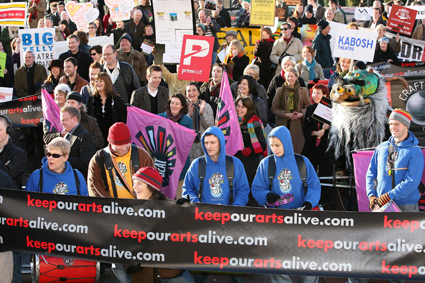
The ACNI’s Multi Annual funding programme has already been discontinued, and it warns that many more programmes and organisations will lose funding if the proposed budget goes ahead. A rally was held yesterday at Stormont to demonstrate support for the arts in Northern Ireland:

Arts Sector rally to Save the Arts (link)
10/12/2007

Northern Ireland ’s arts sector, supported by the Arts Council, today organized the Keep Our Arts Alive rally in a bid to save the arts and to improve the allocation contained within the Draft Budget 2008-2011, currently out for public consultation and which closes on 4th January 2008.

The arts in Northern Ireland are in danger of dying from neglect. That was the message of artists, arts professionals and supporters who gathered at Carson’s statue at Stormont to make a public call for increased arts funding.

Dressed in costume and carrying the tools of their arts and banners, supporters presented the Chair of the CAL Committee, Barry McElduff, with a letter which calls upon government to rethink the final budget settlement. This letter explained how the draft budget proposal pushes the sector into continuing downward spiral of decay and highlighted the negative impact it will have on the economy as a whole.

Artists Danny Devenney and Mark Ervine also unveiled a blank canvas to represent Northern Ireland without art – a consequence that Northern Ireland may have to tackle.

The advantages to be gained from meaningful investment in the arts have not been recognised by Northern Ireland’s main political parties, which gave overwhelming support in October to a Private Members’ Motion, calling on the Executive ‘to raise the level of arts funding to at least the United Kingdom average within the forthcoming Comprehensive Spending Review’. Regrettably this support is not reflected in the Draft Budget.

Speaking on behalf of the arts sector, Ali FitzGibbon, Director, Young at Art said, “The arts industry desperately needs this investment and has shown it is necessary to a peaceful, fair and prosperous society. All the parties backed a bid for parity of funding. *Over 70% of the population attends arts and culture events and 78% believe it should be funded. The case has been made and the priorities and budget must follow suit and increase spending on the arts to a realistic level.”

Roisín McDonough, Chief Executive, Arts Council of Northern Ireland, commented, “If the allocation is not increased this will have devastating consequences for the arts sector. Our artists and core organisations will face a bleak future, and pressing developmental work will not be undertaken.”

“The people of Northern Ireland deserve the same cultural entitlement as their neighbours on these islands and I am asking everyone who understands the rewards to be found from investment in the arts to make their feelings clear during the public consultation process. The Northern Ireland Assembly must rethink its budget allocation for the arts.”

To find out more about the campaign to improve the funding situation for the arts in Northern Ireland, visit www.keepourartsalive.com, visit the Arts Council of Northern Ireland’s ‘Campaigning for the Arts’ webpages or telephone (028) 9038 5200.

*Arts and Culture, (2004), Arts Council of Northern Ireland Study