The masses mass for Picass(o)

picasso-elite-460_1006484c

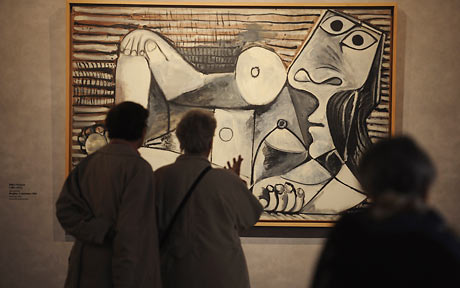
Having my daily breakfast of espresso and Euronews, I was amazed to see a story on the public response to the Picasso exhibition currently on at the Grand Palais in Paris… the show’s about to close, and tens of thousands of people apparently queued overnight to catch a last glimpse of the works. To facilitate the crowds the Grand Palais hosted a marathon 83-hour viewing session. According to the accompanying article on the Euronews website, more then 700,000 people have visited the exhibition since it opened in October.

And yet the spirit of liberté, égalité, fraternité has not graced all quarters, with detractors late last year describing the populist shows as ‘a cancer’ in the Parisian art world.

Elsewhere the arts democracy has gained stronger footing, as the BBC last Wednesday announced its intent to put 200,000 paintings in public ownership online, and the imminent appointment of a new arts editor and arts board to enhance coverage. This follows on too from the innovative move by the Prado in early January to place some of its greatest paintings on Google Earth in extreme high resolution, allowing online viewers to see the works in astonishing detail.

And yet, I can’t help but feeling a mixture of exhilaration and depression at such news… imagine an RTE arts board? The public queuing for hours to see a National Gallery exhibition? Irish paintings in the public ownership actually (gasp!) online? What happens to a dream deferred…

Funding cuts in the arts: opportunity knocks?

An interesting article by Mick Heaney appeared in the Sunday Times on Jan 25th, calling on arts organisations to become more creative in their approaches to funding in a climate of recession (apologies, no link seems to be available!). While I would agree with some of the article, especially his suggestion that arts organisations need to diversify their income in order to better weather recessions, I would take issue with some of his points:

(1)

First is his use of statistics to highlight areas of the arts sector worst hit by the Arts Council recent budget cuts: when it comes to numbers and percentages, it’s easy to arrive at a multitude of conclusions to suit one’s own argument. Heaney asserts that theatre suffered the largest cutback (-12.7%), but he is including in his numbers The Abbey’s funding (which distorts the picture, as they are on a separately-assessed funding track)– whereas Deirdre Falvey in the Irish Times in December had come up with dance as the worst hit (-11%), followed by literature (-9.5%, a significant part of this owing to the axing of the Irish Writer’s Centre annual grant), and finally theatre, less the Abbey’s data (-8.37%). Although this is perhaps a minor point, it’s easy for such numbers to be manipulated, and such figures should be reported carefully. I also frequently see articles on the arts making claims using absolute statistical data, rather than adjusting numbers for inflation to arrive at their real equivalent– not so much an issue when the gap is a year or two, but significant when discussing growth/decline over a decade.

(2)

Second is his statement (which reads as a criticism):

The most obvious legacy of the boom years is the stratum of administrators who run the sector. While such professional expertise may be necessary to run companies efficiently, their support role has increasingly been placed at the heart of the arts sector: few organisations are contemplating laying off the backroom staff; the need to preserve professional experience is a mantra that pops ups repeatedly.

The problems with this are threefold: one, what basis is there for stating that managers’ support role has increasingly been situated  ‘at the heart’ of the arts sector? Again this seems a subjective claim; I might equally counter with the argument that the Arts Council has increasingly swung back towards grants for individual artists (as Heaney himself points out), the culture of arts managerialism is far less developed here than in the UK or the US, and if arts managers in the past few years have seemed more numerous, that’s probably due to the growth of the arts sector overall in the country, not their displacement of creative folks within organisations. Also, Heaney makes quite clear in the article that he supports the diversification of organisational income, to lessen reliance on government funding– and yet, this is the type of goal only achievable by the addition of managerial staff with expertise in marketing, development etc. Finally, as someone who manages an arts jobs webpage and has close contact with people entering the Irish arts workforce, I would suggest that while layoffs do not yet seem to be happening, there is a definite slowdown of new hires and staff turnover.

(3)

Third is his claim that ‘the increase in funding has not brought a similar upsurge of quality art (…) well-crafted but generic work… has dominated Ireland’s well-funded art sector’, and that the recession may offer ideal conditions for artistic innovation. Yet all of his examples are drawn from theatre– obviously the art form he knows best, but not a claim I would dare to make about the arts sector as a whole, let alone theatre (any views out there in agreement, or to the contrary?) What would Theatre Forum think? (WWTFT?)

However I do think it’s useful that the article contributes to the discussions happening now in response to cutbacks, as the Arts Council is forced to make tough choices. The responses for-and-against cuts to the Irish Writers Centre in particular (see Jan 13, Jan 15, Jan 17 and Jan 24 in the Irish Times) and the elimination for funding for Cork Opera 2005 (see 24 Jan and 27 Jan) can obscure the view that I share with Heaney: there shouldn’t be room for complacency in the arts sector, and those organisations, companies and artists who excel at what they do will survive and indeed flourish in spite of the downturn.
New Arts Council Chair & members announced

I’ve been laid low with the flu for the last week (and still recovering!), so sorry for lags in posting/updates! A bit of big news in the meantime:

17 December 2008: Arts Council Director welcomes new Arts Council members

The Director of the Arts Council, Mary Cloake, today welcomed Pat Moylan as chairperson of the Arts Council, as well as new Council members.

“I am delighted to welcome Pat Moylan as the new chairperson of the Arts Council, and my staff and I are looking forward to working closely with her in the weeks and months ahead,” said Ms Cloake.

“The arts are part of us all; they define us as a society and our artists shape our future. In these straitened economic times, the new Council will be working harder than ever to promote the value of the arts, and ensure that people right across the country experience the best of the arts,” Ms Cloake added.

Along with Ms Moylan, the members announced today by the Minister for Arts, Sport and Tourism, Martin Cullen TD, are: Louise Donlon; Paul Johnson; Fiona Kearney; Sheila O’Neill; Orlaith McBride; and Caroline Senior.

Ms Moylan and the new members of the Council join the six current members: Maurice Foley, deputy chairperson; John Crumlish; Philip King; Aibhlín McCrann; Alan Stanford; and Colm Tóibín.

Ms Cloake also paid tribute to the outgoing members: “On behalf of all staff who worked with the outgoing Chair, Olive Braiden, and Council members, I would like to express my thanks to them for five years of hard work and commitment” said Ms Cloake.

(read the rest of the release)

Institute for Cultural Diplomacy – upcoming programmes

cultural-diplomacy-berlin

For those interested in international cultural diplomacy:

The Institute for Cultural Diplomacy (ICD) is pleased to announce four programs taking place in Berlin, February 2009. All programs are currently accepting applications.

  • Institute for Cultural Diplomacy programs- February 2009:
  • The ICD Academy for Cultural Diplomacy ( 2 – 6 February 2009)
  • Europe Meets Latin America: A Forum for Young Leaders ( 9 – 13 February 2009)
  • Cultural Diplomacy in Europe: A Forum for Young Leaders (16 – 20 February 2009)
  • Cultural Diplomacy in Africa: A Forum for Young Leaders (23 – 27 February 2009)

The ICD is an international, not-for-profit, non-governmental organization focused on the theoretical and practical promotion of cultural exchange as a tool for improving relations in all areas. To learn more about our activity, please visit www.culturaldiplomacy.org.

Continue reading

Internship opportunities for young cultural policy researchers

praxis

Dig policy in a serious way, and looking to get experience internationally? Does the mere mention of ‘Brussels’ send a shiver of pleasure down your spine? The European Network of Cultural Administration Training Centres (ENCATC, of which we at UCD are members) have recently distributed a bulletin listing a number of internship/traineeship opportunities available across Europe. A sample:

  • Traineeship at the European Commission in Brussels
  • Cultural Diplomacy Latin America Internship in Berlin
  • Orchestral Tours Internship in London
  • European Commission Delegation to the UN in New York

See the bulletin for details of all opportunities and application information.