Weekly round-up: 17 November 2010

Lots of gloomy news this week– but some bright spots for the arts:

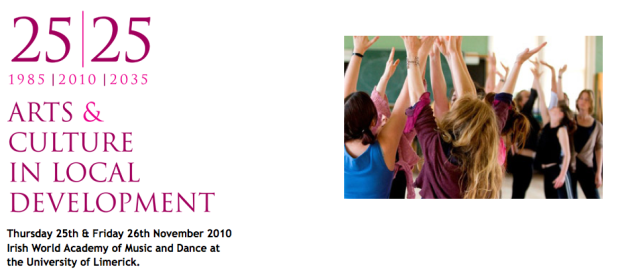
25:25 – Conference on Irish Local Arts Development

University of Limerick is playing host to a conference marking the first appointment of a local authority arts officer in Ireland, focused on the subject of local arts provision and development:

To mark this 25 year partnership, and under the auspices of our relationship with the County and City Managers Association, the  Arts Council and the Association of Local Authority Arts Officers are together organising a conference on local arts development. With guest national and international speakers, the conference will explore the role of the arts and culture in achieving local economic and social development objectives, and how we can unlock the potential of future integrated planning in these areas.

The keynote speaker is Jon Hawkes, a well-known figure in the Australian cultural policy scene, along with lots of other interesting speakers, particularly from the policy & planning side of things.

New Media Mentoring Scheme – reports published

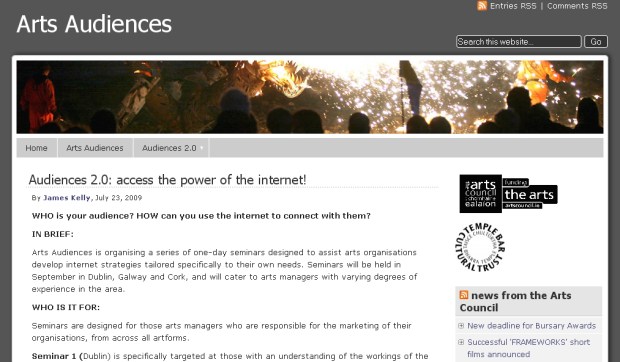
Arts Audiences is an Arts Council and Temple Bar Cultural Trust- sponsored initiative aimed at supporting & delivering audience development projects in cooperation with various arts & cultural organisations.

One of their programmes is the New Media Mentoring Scheme, which has just published a series of reports from the mentor/mentee relationships, which included:

  • John Tierney of Google Ireland mentored Conor Malone, General Manager of Balor Arts Centre (using Google AdWords)
  • A team from Google Ireland mentored Tara Connaghan Artistic Director of Éigse Carlow Arts Festival (using Google Ads and Google Analytics)
  • A team from Google Ireland mentored Michelle Dillon, Marketing Officer of The Dock (balancing time and resources spent on website and on social media platforms)
  • A team from Google Ireland mentored Derek Kelly, Box Office Manager of The Gate Theatre (increasing traffic to website)
  • Aoife Flynn of asquared mentored Rayne Booth of Temple Bar Gallery & Studios (developing a website brief)
  • Lucy Campbell and Muire Laffan of RTÉ Publishing mentored Emmet Sheerin and Anne O’Gorman from NYCI (developing web strategy)
  • Aoife Flynn mentored Marcella Bannon of Droichead Arts Centre (developing digital marketing strategy)

I was particularly interested to read the reports of Michelle, Rayne and Emmet, all (relatively) recent graduates of our MA programme. It sounds like some very valuable reflections and progress was made as a result of the collaborations; for example:

Continue reading

Giving interns a fair deal

I read with great interest a recent report from the UK-based Institute for Public Policy Research (IPPR) on the subject of internships, employment law and ethics, entitled ‘Why Interns Need a Fair Wage‘. The report challenges the system of unpaid internships across the private and public sectors (including politics, business, law, media, fashion, the arts and non-profits), arguing that this structure:

  1. often violates UK employment law by denying interns minimum wage compensation to which they are legally entitled
  2. perpetuates inequalities in many professions by effectively denying entry to individuals without financial means to support themselves during long internship periods (3 mos-year, typically)
  3. further excludes people without family backgrounds in certain professions, owing to their lack of networks/contacts necessary to secure unadvertised but valuable internship places
  4. creates an ethical quandry for organisations who declare themselves to be pro-diversity and pro-access, whilst maintaining internship programmes that are exclusionary in nature

Continue reading

‘Arts Audiences’ new site launch & upcoming web 2.0 event

arts_audiences

The Arts Council, in collaboration with Temple Bar Cultural Trust, has rolled out a new site focused on Irish arts audience development, www.artsaudiences.ie.  Here’s the skinny on their rationale for the initiative:

  1. Attendance and consumption; attendance for some artforms is falling; we need to increase the frequency with which people come to, for instance, our venue or festival and we need to keep people coming back year-on-year.
  2. Customer service and experience; customers care about more than just the show or event and we need to see what we can do to make sure their experiences are good ones
  3. Working together; arts organisations should collaborate more to speak to and attract audiences
  4. New media; All of us need to know more, to help us take advantage of the opportunities which a new media landscape have brought. We recognise that organisations operate at different levels of online activity and will strive to reflect this as we address this.
  5. Information; we need to address the gaps in our information about audiences – who they are and how they behave. Figuring out what we need to know is a key step in figuring out what to do.

(see the full manifesto here.)

Plans so far include:

  • A low-tech no-cost project where arts organisations will recommend each others work and we will report on what worked and what didn’t
  • A large-scale national promotion of the performing arts for a period of time in the autumn

Future plans include online resource material, and new training & mentoring programmes.

More imminent, however, is a series of one-day workshops on Web 2.0 and audience development to be offered in Dublin, Galway and Cork in September. They’re looking for registration ASAP, unless the slots have been filled already… it’s only €45 for a full day session, and looks to be a promising build on the excellent Arts Council-sponsored New Media & the Arts conference held last November.

  1. Attendance and consumption; attendance for some artforms is falling; we need to increase the frequency with which people come to, for instance, our venue or festival and we need to keep people coming back year-on-year.
  2. Customer service and experience; customers care about more than just the show or event and we need to see what we can do to make sure their experiences are good ones
  3. Working together; arts organisations should collaborate more to speak to and attract audiences
  4. New media; All of us need to know more, to help us take advantage of the opportunities which a new media landscape have brought. We recognise that organisations operate at different levels of online activity and will strive to reflect this as we address this.
  5. Information; we need to address the gaps in our information about audiences – who they are and how they behave. Figuring out what we need to know is a key step in figuring out what to do.