MA in Arts Management & Cultural Policy: 2009-10

ma_broch

As already mentioned below we’re having an open day here at UCD this Thursday (Feb 19th) to introduce potential students to our two MA programmes in Art History & Arts Management/Cultural Policy.

Click on the image above for a copy of a flier about the Programme.

Please note that the deadline for application for the 2009-10 MA in Arts Management & Cultural Policy is April 15th.

For more information & application instructions, see our website!

For any specific questions, please feel free to contact me directly.

UCD Graduate Open Day – come visit!

ucd_snow

UCD Graduate Open Day

Thursday, 19 February 2009

We’re gearing up here for this year’s annual UCD Open Day, where faculty will be on hand to discuss postgraduate study opportunities at UCD– of particular interest to readers of this blog may be the two MA degrees offered by UCD’s School of Art History and Cultural Policy: the MA in Art History, and MA in Arts Management and Cultural Policy (we also offer MLitt and PhD degrees in both these subjects). A special information session on these programmes will be held from 3-4 pm in J004 (Arts – Newman Building).

The full schedule of the day’s events is located here: http://www.ucd.ie/artsceltic/graduateschool/events/graduateopenday/

Here’s the official blurb from UCD– do come along if you have an interest in further study!

UCD offers a superb range of dynamic opportunities for graduate study and research in the humanities. Leading experts in areas as diverse as film, creative writing, musicology, art history, drama, arts management and cultural policy, languages, literatures, history, folklore and linguistics will be available to guide you through opportunities to deepen your knowledge and enhance your career potential on Thursday 19 February.

Declan Kiberd, Professor of Anglo-Irish Literature & Drama, and Kathleen James-Chakraborty, Professor of Art History, will give short talks on the exciting challenges of graduate study and life at a key-note event at UCD Humanities Institute of Ireland (HII) between 5-6 pm on 19 February. Sandra Walker of UCD Career Development will address issues of career enhancement. This session will conclude with a wine reception at the HII.

For more information, please contact Barbara Gannon, Manager of the UCD Graduate School in Arts and Celtic Studies at (01) 716 8241 or email gs.artsceltic@ucd.ie or Barbara.Gannon@ucd.ie

Irish Book Publishers’ Conference

cleThe Irish Book Publisher’s Association is having their biennial conference on the 21st of February, this year entitled ‘The Burning Issues’.

Lots of interesting sessions planned on managing small presses, negotiating with booksellers, and identifying new markets…

For details see their flier (MS doc file), or alternatively consult their full programme (pdf).

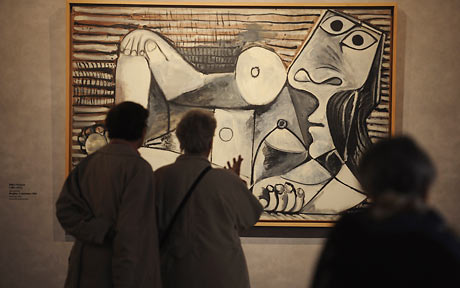
The masses mass for Picass(o)

picasso-elite-460_1006484c

Having my daily breakfast of espresso and Euronews, I was amazed to see a story on the public response to the Picasso exhibition currently on at the Grand Palais in Paris… the show’s about to close, and tens of thousands of people apparently queued overnight to catch a last glimpse of the works. To facilitate the crowds the Grand Palais hosted a marathon 83-hour viewing session. According to the accompanying article on the Euronews website, more then 700,000 people have visited the exhibition since it opened in October.

And yet the spirit of liberté, égalité, fraternité has not graced all quarters, with detractors late last year describing the populist shows as ‘a cancer’ in the Parisian art world.

Elsewhere the arts democracy has gained stronger footing, as the BBC last Wednesday announced its intent to put 200,000 paintings in public ownership online, and the imminent appointment of a new arts editor and arts board to enhance coverage. This follows on too from the innovative move by the Prado in early January to place some of its greatest paintings on Google Earth in extreme high resolution, allowing online viewers to see the works in astonishing detail.

And yet, I can’t help but feeling a mixture of exhilaration and depression at such news… imagine an RTE arts board? The public queuing for hours to see a National Gallery exhibition? Irish paintings in the public ownership actually (gasp!) online? What happens to a dream deferred…

Gloomy days for the arts

It’s feeling cold out there, and not just from the dusting of snow outside this morning.

Continuing on from Friday’s post, this morning’s Irish Times carries two more articles on the effect of the Arts Council’s funding cuts on theatre and music. Peter Crawley reports on the closure of three small production companies (Galloglass, Storytellers and Calypso) as a consequence of the new strategy to cull organisations perceived as artistically weaker from the AC trough, while maintaining funding for the biggies. This predictably has met with mixed reaction, which Crawley (to his credit) fairly assesses, noting that the slippery criterium of ‘artistic excellence’ has served as the fulcrum for artform funding decisions:

There is more sense in the strategy than some would care to admit though. A couple of years ago, during Theatre Forum’s annual conference, one of the best attended and breathlessly titled discussions was: How do we Approach the Issue of Encouraging the Arts Council to Cut Companies Who are ‘Past It’ to Enable New Talent to Breathe?

With the economy then going strong, but arts funding forever in short supply, theatre companies themselves harboured the suspicion that there were simply too many of them to sustain, and that the council was notoriously slow to cull the panjandrums. Now the problem is deciding who’s ‘past it’.

Not an enviable position for David Parnell of the Arts Council, partially tasked with making such artistic evaluations:

The Arts Council will not discuss individual cases with the media, but David Parnell admits that artistic quality is the ultimate measure. In the case of de-funded companies, he says, “ultimately the work is not as good as the work being offered by other organisations, and in the context of shrinking budgets we have to take these difficult decisions . . . Fundamentally, it comes down to the quality of the work offered and the ambition of the work.”

There are familiar complaints as well about the lack of transparency concerning decision criteria and a flawed appeals policy, as well as the interesting suggestion that the shrunken funding pool may push forward a new model for theatre production, away from the company model and towards a new ‘hub’-like structure. Well worth a read…

Michael Dervan offers another take on the harsh economic climate for the arts, revisiting the music cuts which have already been well covered by the IT (Opera 2005 in particular), but mentioning also the anticipated drop in corporate sponsorship:

The nightmares that the banking sector is living through will have consequences for the arts too. Sponsorship and other forms of corporate generosity will be reined in. One of the major musical sponsorships of recent years has been Anglo Irish Bank’s support of the RTÉ National Symphony Orchestra’s subscription series at the National Concert Hall. RTÉ has always given the impression that Anglo Irish managed to strike a happy balance between the supportive and demanding sides of sponsorship, meaning that the bank’s profile in the deal was clear but not obtrusive. Although the sponsorship was a long-term one, it was reviewed – and hitherto renewed – on an annual basis.

However, with the bank in a crisis that has led to its nationalisation, the sponsorship deal, believed to be worth six figures, may not survive assessment in the light of the new realities.

More on this on a forthcoming post, which will review two new reports recently released on philanthropy and sponsorship in Ireland…